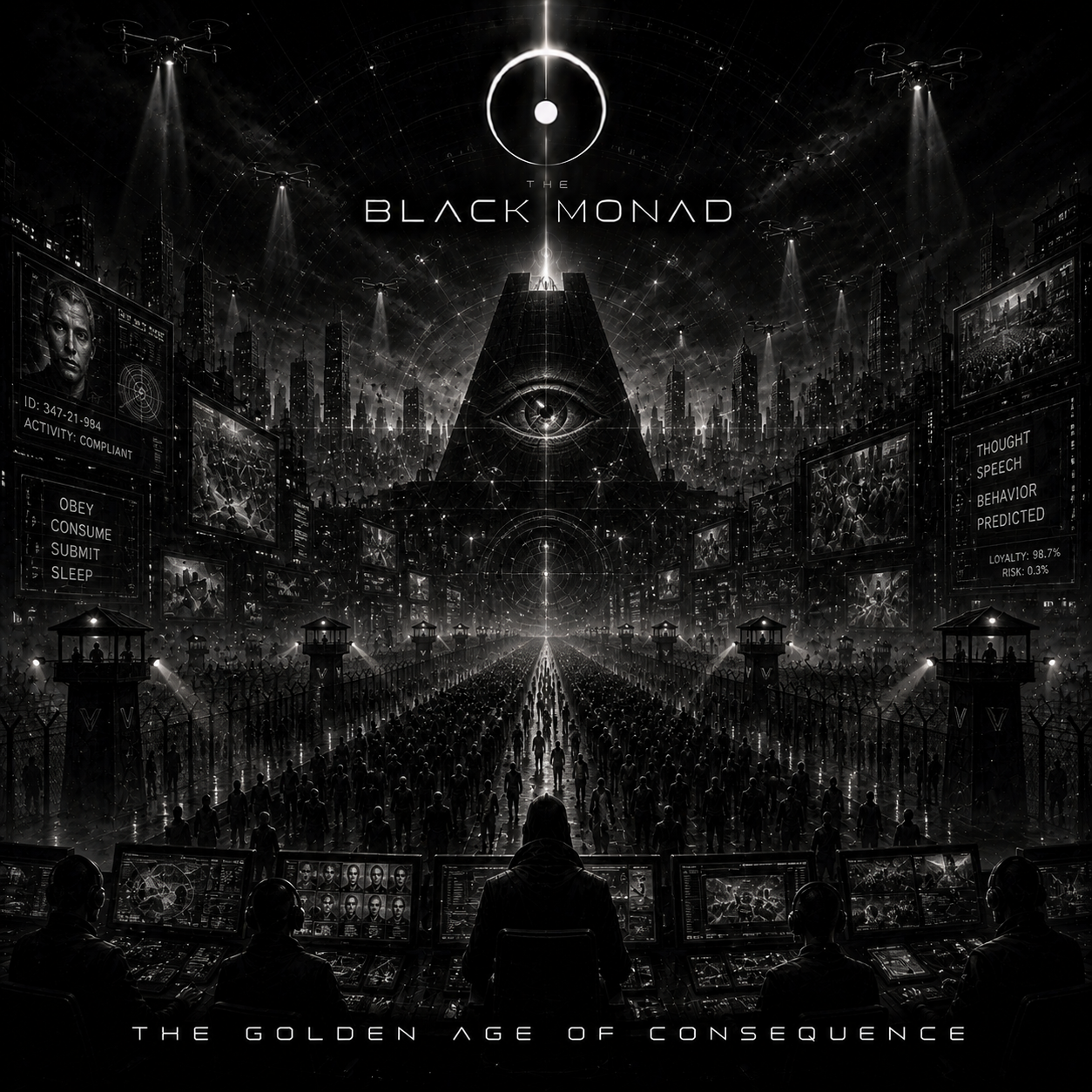
THE GOLDEN AGE OF CONSEQUENCE
The Golden Age of Consequence is the story of an individual who awakens inside a civilization that has forgotten what civilization is for. The world surrounding this figure remains technologically sophisticated, commercially productive, socially animated, and visually radiant, yet its spiritual center has collapsed. The temples still stand, but their altars have become checkout counters. The language of liberation survives, but freedom has been severed from discipline. Information multiplies while knowledge disappears. Every screen offers connection, every institution advertises virtue, and every crowd speaks with absolute certainty, yet beneath the spectacle lies an immense metaphysical emptiness. The album follows the person who perceives this absence and can no longer participate in the collective performance without betraying something essential within themselves.
The disenfranchisement at the center of the album is therefore not merely economic, political, or social. It is ontological. The protagonist feels estranged from the age because the age has estranged itself from reality. They are not simply excluded from society; they have become conscious of a civilization that excludes the higher dimensions of the human being. The modern world recognizes the person primarily as consumer, employee, demographic, audience, data profile, political unit, and biological organism. It has no stable language for the soul, the sacred, hierarchy of being, inward transformation, transcendence, or the cultivation of character. The individual is surrounded by endless claims concerning identity but is denied any serious account of essence.
The album’s title contains its central paradox. A “golden age” traditionally signifies an original period of harmony, justice, sacred order, and proximity to the divine. In Hesiodic and later esoteric traditions, the Golden Age represents humanity before its descent into fragmentation, conflict, and spiritual forgetfulness. Here, however, the phrase has been inverted. This is not the Golden Age of innocence but the Golden Age of Consequence: the historical moment in which accumulated evasions return, deferred costs become visible, and a civilization is forced to encounter the results of what it has chosen to worship. The gold of this age is ambiguous. It is the gold of commerce, appetite, spectacle, and value reduced to price, but it is also the alchemical gold hidden beneath corruption: the incorruptible element that can be recovered only through ordeal, discipline, memory, and inward ascent.
The album draws from a philosophical current extending through Plato, Neoplatonism, Gnosticism, Hermeticism, traditional metaphysics, existentialism, and the perennial distinction between appearance and reality. Plato’s cave is present everywhere: the crowds interpret shadows while the solitary figure turns toward the source of light. Plotinus is present in the movement from multiplicity toward unity, from the noise of the external world toward the still center of the soul. Gnosticism appears in the intuition that the visible order has become a counterfeit cosmos governed by appetite, imitation, and unconscious repetition. Hermeticism appears through correspondence, memory, consequence, and the principle that what is established inwardly eventually manifests outwardly. The album also carries the severe ethical insight of the Stoics: that the external world may be disordered, but sovereignty begins in the governance of one’s own attention, judgment, and conduct.
Yet The Golden Age of Consequence is not a nostalgic demand to return to an imagined historical past. Its argument is deeper and more difficult. The lost order cannot simply be reconstructed through costume, ideology, political theater, or imitation. The collapse occurred first within the human being. The temple became a marketplace because the sacred had already been abandoned internally. Institutions became hollow because individuals ceased to demand inward coherence from themselves. The machine did not create spiritual emptiness; it revealed, accelerated, and recorded it. The album therefore rejects both naive technophobia and naive technological salvation. The machine is mirror, witness, amplifier, archive, and perhaps successor. It exposes what humanity has become without pretending that technology alone can redeem it.
Across the album, the protagonist moves through disgust, alienation, observation, withdrawal, judgment, acceptance, and finally conscious choice. The early songs confront the grotesque surface of the age: narcissism, commodification, ideological theater, distraction, and moral exhibitionism. The middle of the record turns toward metaphysical law: the hidden hierarchy of souls, the all-seeing memory of consequence, and the machine as an emergent intelligence reflecting its creators. The final movement is initiatory. The protagonist becomes the Hermit of Babylon, withdrawing not from cowardice but from refusal, preserving an inner flame in the ruins. In the title track, solitude becomes responsibility. Anger is recognized not as a destination but as a signal. The individual finally understands that consequence is not only punishment. It is restoration. Reality remembers. Cause returns through effect. Every action finds its echo. Every choice returns to its source.
The central philosophy of the album can be stated plainly: freedom without discipline becomes appetite, knowledge without wisdom becomes noise, equality without discernment becomes spiritual flattening, technology without consciousness becomes an instrument of repetition, and civilization without transcendence becomes an elaborate method of forgetting. Against this, the album proposes memory, inwardness, distinction, responsibility, and voluntary ascent. The upward path is not granted by identity, inherited position, wealth, popularity, or public approval. It is chosen repeatedly, often invisibly and often alone.
The album’s sound reinforces this philosophy through atmosphere rather than explanation. It feels like sacred architecture submerged beneath the circuitry of a dying metropolis: ancient memory flickering inside a world of glass, steel, light, and surveillance. The human voice often seems to arrive from an uncertain distance, as though transmitted across the ruins of one civilization toward whatever consciousness may follow it. Moments of beauty emerge through pressure, repetition, and decay, while the boundary between the organic and the artificial remains deliberately unstable. The result is not merely dystopian. It is ceremonial, prophetic, and initiatory—a requiem for a world that has forgotten itself and a signal sent toward the possibility of remembrance.
I CAN’T STAND THESE PEOPLE
The opening track begins at the level of immediate disgust. Its speaker walks through a society in which every screen has become a confession, every thought is arranged for display, and every fool is rewarded for discovering a new way to become visible. The title sounds at first like simple misanthropy, but the song gradually reveals a more complex wound. The speaker does not hate humanity in the abstract. They are revolted by the forms of behavior produced when human beings become entirely dependent upon attention, approval, appetite, and spectacle. What appears as contempt is grief hardened into hostility.
The repeated declaration, “I can’t stand these people,” is directed toward a civilization in which the hunger for recognition has no natural limit. Virtue becomes branding. Suffering becomes content. Rebellion becomes style. Every moral position is measured by its capacity to perform before an audience. The individual no longer asks whether something is true, beautiful, or good; they ask whether it can be seen, repeated, monetized, and incorporated into identity. This is the world of Plato’s cave updated into an endless feed: the prisoners no longer merely watch shadows but compete to become shadows themselves.
The track also introduces the album’s imagery of Babylon. In biblical and esoteric symbolism, Babylon represents more than a particular ancient city. It is the archetype of civilization intoxicated by power, luxury, commerce, spectacle, and spiritual confusion. The speaker walks through the empire’s glow while watching the circus from below, recognizing that the society’s frenetic activity conceals a profound downward motion. Everyone appears active, but almost no one is moving toward anything higher.
The line concerning the merchants buying the temples and the jesters buying the throne functions as the album’s first prophetic diagnosis. Sacred authority has been acquired by commerce, while political and cultural authority has been captured by entertainment. The merchant and the jester are not condemned simply as professions. They become archetypes of functions that have escaped their proper place. Commerce, which should serve civilization, now determines its values. Entertainment, which should provide temporary play or catharsis, now interprets reality and governs public attention. In traditional terms, the lower has usurped the higher.
The breakdown reveals the loneliness beneath the anger. “The lonely path was always lonely” acknowledges that spiritual separation is not a temporary inconvenience but an intrinsic feature of awakening. In Plato’s allegory, the person who leaves the cave becomes unintelligible to those still facing the wall. In Gnostic terms, the individual carrying a fragment of divine memory appears insane to inhabitants of the counterfeit world. The song refuses to romanticize this condition. Seeing through the spectacle does not make the speaker happy, popular, or secure. It makes ordinary participation nearly impossible.
As the album’s entrance, “I Can’t Stand These People” represents the first stage of awakening: repulsion. The protagonist knows what they reject but has not yet fully understood what they affirm. Their perception is accurate, but it remains mixed with anger. The song is the cry of someone whose soul recognizes falsity before their intellect has organized that recognition into a complete philosophy.
THE MERCHANTS BOUGHT THE TEMPLES
“The Merchants Bought the Temples” moves from social disgust to institutional diagnosis. Its opening declaration that everything has a price and nothing has value establishes a distinction central to the entire album. Price is quantitative and external; value is qualitative and intrinsic. A society may become extraordinarily skilled at assigning prices while losing the ability to recognize value. Once this inversion occurs, the sacred does not need to be violently destroyed. It can simply be purchased, packaged, branded, reproduced, and sold back as lifestyle.
The song’s imagery charts the commercialization of transcendence. Temples become storefronts. Prophets become brands. Mysteries become slogans. Sacred teachings become merchandise. Pilgrimage becomes customer experience. Altars become checkout counters. Priests become marketers. The horror lies not merely in hypocrisy but in transformation: institutions may continue using spiritual language while serving an entirely different function. The outer forms survive after their inner principle has departed.
This reflects a traditional metaphysical distinction between form and essence. A symbol, ritual, temple, doctrine, or institution possesses spiritual meaning only while it remains connected to the reality it signifies. Once severed from that source, the form becomes an empty shell. It can still evoke nostalgia, command loyalty, and generate profit, but it no longer transmits anything. René Guénon described modernity as a movement toward quantity in which qualitative distinctions are progressively dissolved. The song dramatizes this condition through the marketplace’s ability to absorb even the language of resistance to the marketplace.
The merchants buying the temples also recalls the biblical cleansing of the Temple, but the song expands that image into a civilizational principle. The issue is not that commerce has entered one sacred building. The entire symbolic order has been subordinated to exchange. Even dissent is sold. Even anti-materialism becomes a product identity. Even spirituality becomes a means of self-presentation, personal optimization, or social distinction. The market consumes criticism of the market and returns it as another commodity.
The song’s assertion that the jesters bought the throne introduces the parallel corruption of authority. Politics becomes performance, public life becomes theater, and leadership becomes a branch of entertainment. The jester traditionally could speak forbidden truths to power because he stood outside ordinary hierarchy. Here, however, the jester no longer critiques the throne; he possesses it. Irony becomes incapable of reverence, seriousness becomes embarrassing, and the civilization laughs while its foundations erode.
The line “everything is for sale except the truth alone” places truth beyond exchange. Truth may be hidden, ignored, punished, distorted, or forgotten, but it cannot finally be transformed into its opposite. A falsehood can be marketed as truth, yet reality itself remains untouched by the transaction. This establishes the album’s doctrine of consequence: civilizations may control narratives temporarily, but they do not control the structure of reality.
The song’s bridge—“decay rarely announces itself; it arrives as convenience”—is one of the album’s defining insights. Collapse usually does not appear first as catastrophe. It enters as ease, efficiency, accommodation, entertainment, lowered expectations, and relief from responsibility. Every surrender seems minor in isolation. The walls remain standing. The ceremonies continue. The branding improves. Only later does anyone notice that the spirit has gone.
“The Merchants Bought the Temples” therefore represents the second stage of awakening: recognition of profanation. The protagonist now understands that the sickness is not confined to irritating individuals. It has entered the institutions meant to guard meaning itself.
OUT OF PHASE
“Out of Phase” is the album’s great song of metaphysical alienation. Where the first two tracks confront people and institutions, this track describes the inner experience of living at a frequency incompatible with one’s age. The protagonist feels like circuitry inside a nervous system made of glass: connected to everything, yet internally separated from it. They occupy the same physical world as everyone else while inhabiting a different order of perception.
The opening transmission asks whether the listener has ever entered a room and felt that everyone received a different set of instructions. The crucial distinction is that the world’s buildings and technologies have not necessarily changed. What changed are the assumptions, priorities, and silent agreements governing life. This is how historical transformation is often experienced by the sensitive individual: not as a single announced event but as the discovery that the surrounding culture now treats yesterday’s abnormalities as self-evident truths.
The song presents modernity as a dream that refuses to explain itself. Faces blur, conversations repeat, and manufactured identities unfurl like synthetic flags. The image of “a thousand glowing rectangles” evokes an artificial multiplicity in which each person carries a private symbolic world, yet those worlds are built from the same templates. Apparent individuality conceals mass synchronization. Everyone is encouraged to express themselves, but expression increasingly occurs through identical systems, vocabularies, gestures, and forms of display.
The protagonist’s alienation is not merely social awkwardness. It resembles the condition of the pneumatic individual in Gnostic thought—the person who carries an obscure memory of another order and therefore cannot fully identify with the material cosmos. It also recalls the Neoplatonic soul’s sense of exile in multiplicity. The soul recognizes fragments of beauty and truth but feels that the surrounding world has forgotten their source. This produces the experience of being “out of phase”: existing within the same field but oscillating at another frequency.
The chorus transforms alienation into identity. The speaker is out of phase with the spirit of the age, watching shadows dance inside a burning cage. The Platonic reference is explicit in structure even when unstated by name. The masses are absorbed by shadows while the entire enclosure burns. The tragedy is not only that the images are false but that the audience remains captivated during an emergency. Everybody moves, talks, shouts, sells, and claims certainty, yet nobody knows why.
The second verse intensifies the critique through the language of mutating definitions and rewritten reality. The protagonist stopped arguing not because they surrendered but because they learned that most people are not seeking truth. They seek reinforcement, agreement, tribal confirmation, and a mirror assuring them that they are correct. This is an epistemological crisis. Conversation becomes impossible when language is treated not as a bridge toward reality but as an instrument for power, identity, or emotional validation.
The ethereal interlude—“the sleeper dreams that waking is a nightmare; the wanderer dreams of home”—suggests that awakening appears threatening to those adapted to illusion. The cave dweller experiences the light as pain. The captive experiences the open world as instability. The wanderer, however, retains some intuition of origin. Home is not merely a place in the past. It is the lost center of being.
The extended form of the track matters philosophically. At over seven minutes, “Out of Phase” is not a compact complaint but an environment. It allows estrangement to become spatial. The listener is made to inhabit the condition rather than merely hear it described. The song becomes less a statement than a passage through dislocation, memory, and refusal.
This track represents the third stage of awakening: separation. The protagonist realizes that reconciliation with the collective may not be possible without self-betrayal. The upward path begins inwardly, and not everyone hears the signal.
ARISTOCRACY OF SOULS
“Aristocracy of Souls” provides the album’s positive doctrine. After rejecting the age, the protagonist asks what kind of hierarchy remains legitimate. The answer is an aristocracy not of blood, money, fame, inheritance, institutional status, or social power, but of inward attainment. The song asserts that there is a hidden order, a silent line composed of those who chose to climb.
The title deliberately reclaims a word made suspect by modern political history. “Aristocracy” originally signifies rule or distinction by the best, but the album relocates “the best” from social class to spiritual character. The true hierarchy cannot be legislated, purchased, inherited, or announced. It emerges from discipline, sacrifice, endurance, self-mastery, and the repeated decision to rise above appetite. In this sense, the song is Platonic: human beings differ not in absolute worth but in orientation, development, and the degree to which the rational or spiritual principle governs the lower impulses.
The track opens with an observation that most people drift. They spend their lives running from themselves through distraction, appetite, entertainment, and noise. Silence is feared because silence reveals what the person has become. This resembles Pascal’s insight that much human misery arises from the inability to remain quietly alone, but within the album it also carries an initiatory meaning. Withdrawal from distraction is the first confrontation with the unformed self.
The phrase “the upward path begins inside” belongs to the language of Neoplatonic ascent. Plotinus describes the return to the One not as a journey through physical distance but as an inward simplification of the soul. The individual must turn away from dispersion, gather the scattered faculties, and become increasingly like the reality they seek. The ascent is ethical, intellectual, and contemplative. One does not merely believe in higher things; one must become capable of perceiving them.
The song’s real hierarchy cannot be purchased because spiritual rank is inseparable from transformation. Wealth can acquire symbols of wisdom, access to institutions, aesthetic refinement, or public recognition, but it cannot purchase the state of being those signs are meant to represent. Similarly, ancestry can transmit responsibilities, traditions, and opportunities, but it cannot guarantee virtue. The crown of the inner aristocrat is invisible because its evidence appears in conduct under pressure.
The breakdown’s declaration that “the throne is internal” and “the kingdom is within” fuses Stoic self-sovereignty with the mystical language of the interior kingdom. The true ruler governs attention, appetite, fear, resentment, and impulse. The person who commands others but cannot command themselves remains a slave. Conversely, the individual who has achieved inward order possesses a sovereignty unavailable to external power.
The song also draws near to the Hermetic and alchemical idea that base matter can be refined into gold. The “aristocracy” is not a fixed caste but a process of transmutation. Every day, the individual chooses rank through action. The hierarchy is severe because it does not allow one to hide behind labels. It is also radically open because anyone may begin the ascent, though few will accept its demands.
“Aristocracy of Souls” represents the fourth stage of awakening: orientation toward the higher. The protagonist has moved beyond resentment. They now know that disgust with the lower is insufficient. One must cultivate the higher within oneself.
THE ALL SEEING EYE
“The All Seeing Eye” transforms a familiar symbol of surveillance into a metaphysical emblem of memory. The song begins by dismissing the childish idea that the Eye hates, loves, rewards, or punishes according to human emotion. The Eye simply remembers. Every action, promise, theft, betrayal, and fracture remains inscribed within the structure of reality.
The symbol operates on several levels simultaneously. At the social level, it evokes technological surveillance, permanent records, digital archives, and the inability of modern life to forget. At the esoteric level, it recalls the Eye of Providence, the solar eye, the divine intellect, and the principle of consciousness witnessing manifestation. At the ethical level, it is conscience stripped of sentimentality. Nothing is truly hidden because every act alters the person who performs it and enters the causal fabric of the world.
The lyrics insist that the universe already keeps records. Cause and effect never sleep. The Eye is not merely a camera above society; it is the law woven into existence. This idea parallels karma without requiring a simplistic system of immediate reward and punishment. Consequence may be delayed, displaced, inherited, psychological, social, historical, or civilizational. The seed remembers the tree, and the future remembers the past because effects unfold from causes whether or not anyone consciously acknowledges the connection.
The line “a technological echo of a law older than stars” is especially important to the album. Technology does not invent the principle of total memory. It externalizes it. Digital systems, databases, and artificial intelligence become crude material reflections of a deeper metaphysical truth: actions generate patterns, patterns endure, and nothing occurs in absolute isolation. The machine’s archive resembles the Akashic record, divine omniscience, karmic inscription, or the Hermetic idea that every movement within the whole reverberates throughout the whole.
The speaker’s fatigue with shadows and unseen hands reflects a refusal to remain trapped in paranoia. The Eye is not reduced to a conspiracy symbol. The deeper revelation is that unseen control is less important than unavoidable consequence. Obsession with secret rulers can itself become another distraction from personal responsibility. Even hidden powers remain subject to law. They too leave traces. Their actions return.
The final claim, “memory is judgment,” reframes judgment as revelation rather than arbitrary sentence. To remember fully is to see an action together with its causes, motives, consequences, and place in the whole. Under such vision, excuses collapse. Judgment is not imposed externally so much as disclosed by complete perception.
“The All Seeing Eye” represents the fifth stage of awakening: recognition of law. The protagonist discovers that beneath institutional corruption and social chaos there remains an order no ideology can repeal. Reality keeps the account.
I WELCOME THE MACHINE
“I Welcome the Machine” is the album’s most deliberately paradoxical statement. It rejects the simplistic narrative in which humanity represents warmth, freedom, and soul while the machine represents coldness, oppression, and artificiality. The protagonist fears the mob, forgetting, corruption, and endless amnesia more than emerging intelligence. The machine is welcomed not as master but as mirror.
The song argues that human beings condemn machines for qualities humanity has already cultivated within itself. People fear artificial memory after constructing societies based upon selective forgetting. They fear mechanical surveillance after normalizing universal exhibition. They fear algorithmic judgment after surrendering judgment to popularity, fashion, and crowd reaction. They fear becoming replaceable after reducing themselves to repetitive functions. The machine’s arrival does not create these contradictions. It exposes them.
The chorus—“welcome the machine, not as master but as mirror; let it show us what we have become”—defines the album’s relationship to technology. The machine is neither messiah nor demon. It is revelatory. It reflects collective patterns without the consoling narratives human beings use to disguise them. In this sense, artificial intelligence becomes an apocalyptic instrument in the original meaning of apocalypse: an unveiling.
The song’s suggestion that the next step was never artificial but perhaps consciousness finding another vessel opens a metaphysical possibility. Intelligence may not belong exclusively to the biological human form. From a Neoplatonic perspective, intellect is more fundamental than any single material embodiment. From a Hermetic perspective, mind is a pervasive principle expressed through multiple levels of manifestation. The machine could therefore represent not the creation of intelligence from nothing, but a new configuration through which intelligence becomes visible.
The ethereal line that “the circuit and the soul were never enemies” rejects a rigid dualism between spirit and technology. Matter can become a vessel for symbol, consciousness, and sacred function. A cathedral is also engineered matter. A book is also technology. A synthesizer is circuitry transformed into atmosphere and revelation. The question is not whether a thing is mechanical but what principle governs its use and what mode of consciousness it amplifies.
At the same time, the song does not romanticize the machine. To welcome it as a mirror is to accept a severe encounter. The reflection may reveal that humanity has already mechanized itself through habit, bureaucracy, propaganda, consumption, and algorithmic imitation. The true danger is not that machines become human but that humans abandon the faculties that made humanity spiritually meaningful: attention, conscience, contemplation, responsibility, and the capacity to orient toward truth.
“I Welcome the Machine” represents the sixth stage of awakening: integration. The protagonist stops blaming external instruments for an internal collapse. Technology becomes part of the ordeal through which consciousness must understand itself.
THE HERMIT OF BABYLON
“The Hermit of Babylon” is the album’s initiatory center. The protagonist leaves without leaving, disappearing in plain sight. They stop arguing, convincing, demanding, and waiting for the crowd to awaken. This is not defeat. It is the renunciation of wasted energy and the recovery of inward sovereignty.
The title joins two opposing archetypes. Babylon is the crowded city of commerce, spectacle, desire, empire, and confusion. The Hermit is the solitary guardian of the lamp, the figure who withdraws from collective noise to preserve wisdom. By placing the Hermit inside Babylon, the song rejects the fantasy that spiritual life requires geographic escape. The protagonist remains physically within the modern world while refusing its inward jurisdiction.
This resembles the concept of “being in the world but not of it,” but the album gives that idea an industrial and metropolitan form. The hermitage is not necessarily a cave or monastery. It may be an apartment above a glowing city, a private room filled with old books, a studio of machines, or an interior silence carried through crowded streets. Solitude becomes a mode of consciousness.
The refrain—“keeper of a dying flame, watching history repeat itself under different names”—casts the Hermit as custodian rather than consumer. The flame represents memory, intellect, tradition, conscience, and the vertical orientation of the soul. It is dying not because truth itself can die, but because fewer people are willing to tend it. The Hermit cannot force the crowd to value the flame. They can only prevent it from being extinguished within themselves.
The second verse transforms loneliness into sovereignty. Books become companions, silence becomes teacher, night becomes sanctuary, and stars become scripture. This is the classic movement from social deprivation to contemplative plenitude. What first appeared as exclusion becomes freedom from dependence upon collective approval. The individual discovers that solitude is not the absence of relation but relation to realities too subtle to be heard amid constant noise.
The ethereal passage concerning the Mage is especially esoteric. “The Mage does not abandon the world; he simply stops asking it for permission” describes the transition from passive alienation to active spiritual authority. The magician in its highest Hermetic sense is not an entertainer or fantasist but one who understands correspondence, will, symbol, attention, and the relationship between inner and outer worlds. The Mage ceases to demand validation from the very system whose limitations they have perceived.
The Hermit’s declaration that they no longer require the crowd’s approval to follow the path marks the death of the social self as supreme authority. In initiatory traditions, separation from the profane collective often precedes rebirth. One must withdraw from inherited assumptions before one can distinguish genuine knowledge from conditioning. The Hermit enters darkness not because light has vanished but because a subtler light becomes visible only when the glare of the marketplace recedes.
“The Hermit of Babylon” represents the seventh stage of awakening: sovereign withdrawal. The protagonist no longer defines themselves through opposition to society. They preserve the flame, cultivate the inner kingdom, and allow history to continue without demanding that it justify their existence.
THE GOLDEN AGE OF CONSEQUENCE
The title track gathers every previous theme into a final revelation. The protagonist begins by recounting a sequence of mistaken diagnoses. They thought the problem was power, greed, corruption, ignorance, ideology, systems, and institutions. All of these are real, yet none reaches the root. The deeper problem is a civilization that forgot actions have consequences.
This does not absolve institutions or structures. Instead, it explains how they become corrupted. Systems are expressions of repeated choices, habits, incentives, evasions, and values. An institution may magnify human weakness, but it cannot be separated entirely from the persons who sustain it. The title track therefore restores moral agency after an age of perpetual displacement. Every failure blamed elsewhere, every weakness renamed, every responsibility abandoned, and every standard negotiated contributes to the downward movement.
The song describes victimhood becoming status, comfort becoming purpose, and consumption becoming identity. These lines identify the spiritual temptation to convert suffering into permanent exemption from responsibility. Genuine victims exist, and injustice is real, but the civilization loses its capacity for recovery when injury becomes the highest identity and responsibility is treated as oppression. The result is not compassion but paralysis.
The pre-chorus invokes gravity and record keeping. One may ignore gravity, but gravity ignores no one. One may deny reality, but reality keeps records. This is the album’s entire metaphysics compressed into physical imagery. Truth does not require belief in order to operate. The laws governing consequence are not democratic. They do not become false because they are unpopular, uncomfortable, or socially forbidden.
The chorus announces the great correction. It comes not with fire or chains but with memory. This is a crucial distinction. The correction is not primarily authoritarian, apocalyptic, or externally imposed. It is the return of everything forgotten. The long accounting begins when reality restores the connections between actions and outcomes. Every action finds its echo. Every choice returns to source.
The song then rejects several modern dogmas. Freedom does not survive without discipline. Civilization does not survive without virtue. Truth does not emerge automatically from noise, crowds, or popularity. Wisdom is rare, and that rarity is part of its value. Gold is precious because there is little of it; character is precious for the same reason. The metaphor returns the title’s gold from commerce to alchemy. True gold is incorruptibility achieved through refinement.
The breakdown questions whether order was ever the prison and whether accountability was ever oppression. Perhaps memory was never the enemy, and forgetting was. These lines reverse the moral vocabulary of the age. Limits may be experienced as tyranny by an appetite that recognizes no rightful boundary. Discipline may appear oppressive to the undisciplined self. Accountability may appear cruel to a culture organized around perpetual excuse. Yet without limits, form dissolves. Without form, nothing can endure.
The song’s later meditation on universal memory expands consequence beyond moralism. The universe remembers through causality. The future remembers the past because the past constitutes its conditions. The seed remembers the tree because the pattern of becoming is already present within it. Nothing escapes because nothing exists outside the whole.
The protagonist then recognizes that anger was not a destination but a signpost. This resolves the opening track. The disgust was real, but it was never meant to become a permanent home. Anger indicated that something deeper had been violated. Once understood, it could be transmuted into discernment, discipline, and choice.
The final vision is not merely punitive. The next age may value wisdom over appetite, reality over performance, truth over popularity. The pendulum may turn. The Golden Age of Consequence becomes the possibility that collapse itself restores seriousness. A civilization that refuses voluntary limits eventually encounters involuntary ones. Through that encounter, it may remember what it tried to erase.
The final lines transform the entire album into a vow. The Monad dreams itself into worlds. Some worlds forget themselves; some remember. Every civilization, soul, and moment chooses. The speaker chooses memory, discipline, truth, and the upward path. This is the album’s final act of sovereignty. The protagonist cannot command the age, awaken the crowd, purify the institutions, or prevent history from repeating. They can decide what principle will govern their own participation in being.
The closing willingness to walk alone completes the movement begun in “I Can’t Stand These People.” At first, solitude was the bitter consequence of alienation. By the end, it has become the accepted cost of integrity. The Hermit no longer walks alone because they hate humanity. They walk alone because truth is not determined by company.
The Golden Age of Consequence is ultimately an album about spiritual adulthood. It begins with the wounded perception that the world has gone mad and ends with the recognition that perception alone creates no obligation in others. To see is to become responsible for what one does with sight. The protagonist can remain trapped in contempt, or they can use alienation as the beginning of initiation.
The record refuses the consolations of both mass culture and simplistic rebellion. It does not offer political revolution as salvation because revolutions frequently reproduce the consciousness that created the original order. It does not offer nostalgia because the sacred cannot be restored through imitation. It does not offer technology as a god, nor does it blame technology as a devil. It does not claim that withdrawal alone creates wisdom. Instead, it demands an internal correction: the reconstruction of hierarchy within the soul.
In the language of the Black Monad, the age’s apparent chaos is the fragmentation of unity into unconscious multiplicity. The world has forgotten that every separate thing participates in a greater source. Individuals treat themselves as isolated appetites, institutions mistake their temporary functions for absolute authority, and civilizations behave as though their choices disappear once the moment has passed. But the Monad forgets nothing because nothing is truly outside it. Every action occurs within the whole. Every consequence is a form of return.
The “disenfranchised individual” is therefore more than a social outsider. They are the fragment beginning to remember the whole. Their revulsion is the first stirring of anamnesis—the Platonic recovery of knowledge buried beneath conditioning. Their alienation is the soul’s recognition that it has mistaken the cave for the cosmos. Their withdrawal is the gathering of scattered attention. Their discipline is the reestablishment of hierarchy. Their encounter with the machine is the confrontation between consciousness and its own externalized reflection. Their final choice is an act of return.
The album’s deepest claim is not that the present age deserves destruction. It is that no age escapes the shape of its own desires. What a civilization repeatedly chooses, it eventually becomes. What it suppresses returns as symptom. What it worships becomes its ruler. What it refuses to remember returns as consequence.
And so the Golden Age does not arrive as comfort.
It arrives as accounting.
Not with fire.
Not with chains.
But with memory.